A few weeks ago, a friend told me that someone had built a campfire in one of the fields on his farm’s campsite, despite the controversial emergency alert warning of a “very high risk of wildfires nationally”.
More than an acre was subsequently burnt.
It was small compared with the devastating fires witnessed globally, but it made the warning feel frighteningly close. The UK has now recorded more than 1,000 fires already this year.
Concurrently, public consultations on two major North Sea developments, Jackdaw and Rosebank, closed on 10 and 17 August.
Whether they should proceed is a decision many people are struggling with. Watching landscapes burn makes approving major fossil-fuel developments feel instinctively wrong. Yet sustainable growth cannot be reduced to instinct. It must account for climate science, energy security, employment and affected communities.
Two different propositions
Jackdaw is a gas field approximately 150 miles east of Aberdeen. Whereas Rosebank, 80 miles north-west of Shetland, is predominantly an oil field. Both are now operated by Adura, formed from Equinor and Shell’s UK offshore businesses.
Testing the arguments
Claim | Supporting evidence | Qualification |
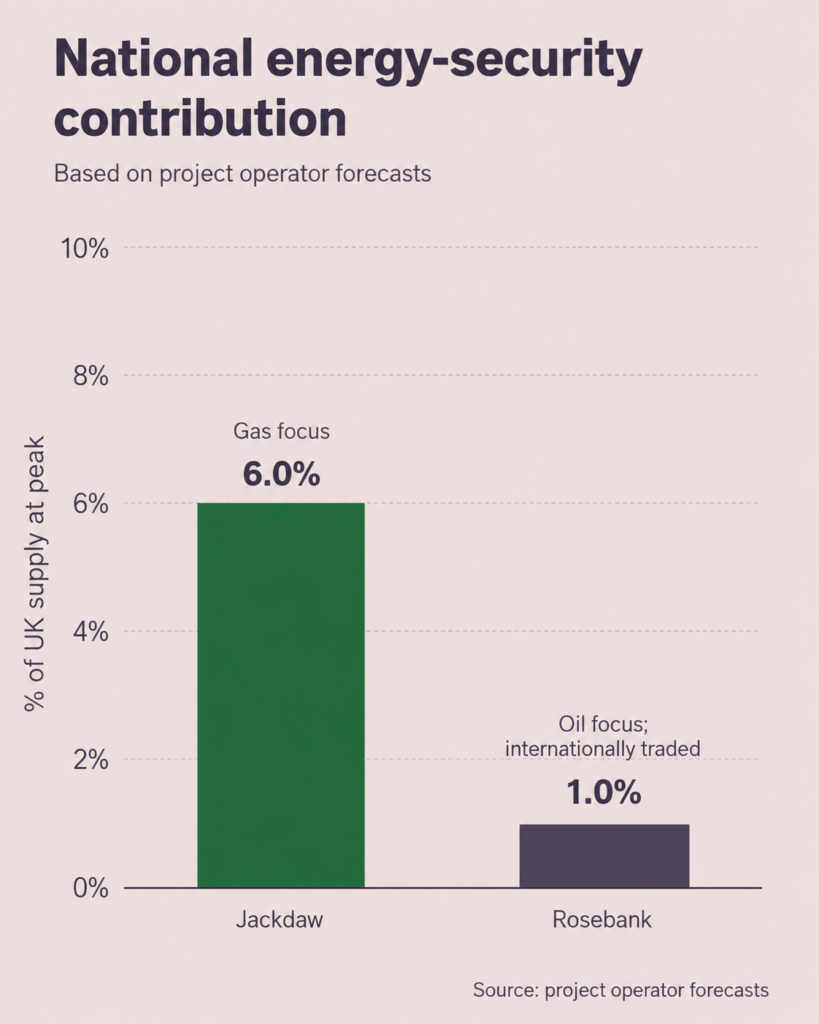
They will improve energy security | Jackdaw could provide around 6% of UK gas supply at peak. With Rosebank, its gas would enter the UK grid through the West of Shetland pipeline. | Analysis suggests Jackdaw may displace only around 2% of current gas imports over its lifetime, and Rosebank around 1%. Rosebank is approximately 90% oil, which would be traded internationally. Neither project is expected to reduce household prices materially. |
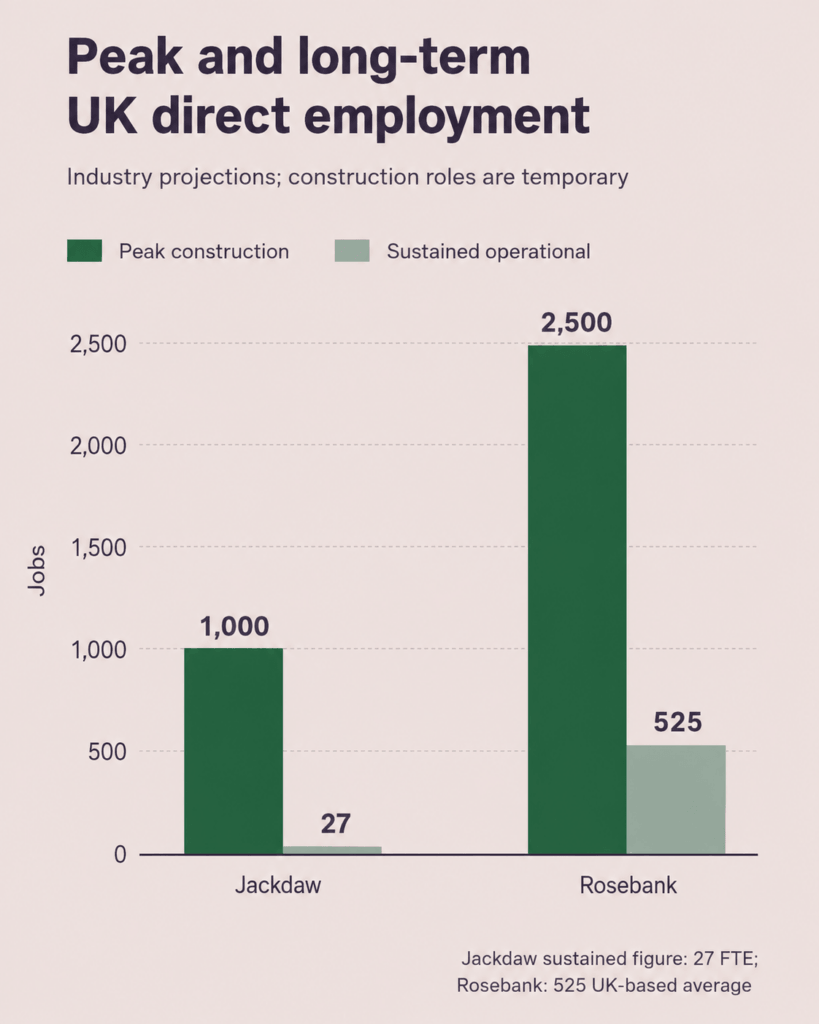
They will protect jobs and investment | Industry forecasts for Jackdaw £10.8bn of investment, more than 3,500 jobs at peak construction and 880 sustained roles throughout production. For Rosebank, Adura attributes £8.7bn of investment and an average of 525 UK-based jobs over its lifetime to the project. | These are industry projections and should not be divided equally between the fields. Peak construction roles are temporary. Jackdaw may create only 27 long-term full-time equivalent (FTE) jobs, although it would support existing Shearwater employment and the wider supply chain. |
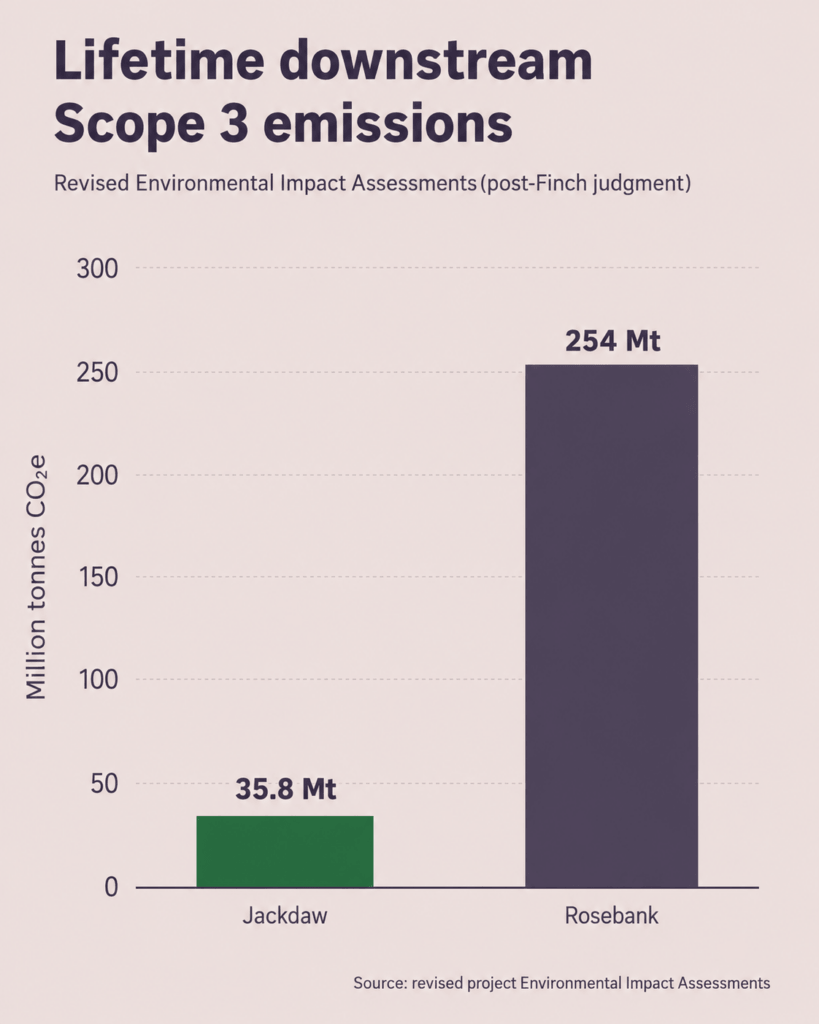
Domestic production is cleaner than imports | For Rosebank, Adura estimates production emissions of around 12kg CO₂ per barrel, potentially falling below 3kg if the platform is electrified, compared with a stated North Sea average of approximately 20kg. Jackdaw would use existing infrastructure and is presented by Adura as a comparatively low-emissions development. | These figures concern operational production emissions. They exclude the much larger downstream Scope 3 emissions from using the fuel: approximately 254m tonnes of CO₂e for Rosebank and 35.8m tonnes for Jackdaw. |
They will generate revenue and fund the transition | Offshore Energies UK forecasts £1.4bn in tax revenue before the end of this Parliament, rising to £3.8bn by 2034. Rosebank’s larger investment means it accounts for much of the economic case, while Jackdaw offers the clearer domestic gas-supply benefit. | Tax forecasts depend on prices, production and available reliefs. Revenue is not automatically ring-fenced for clean energy. Rosebank’s oil and Jackdaw’s gas would still be sold at market prices, limiting any direct effect on bills. |
Rejecting them would avoid major emissions | Rosebank has projected lifetime emissions of approximately 249–254m tonnes of CO₂e. Jackdaw, approximately 35.8m tonnes. Together, they could approach 290m tonnes. | These figures describe gross project-related emissions, not necessarily the net increase in global emissions. Some UK production could replace imports, although additional supply may also sustain fossil-fuel demand and delay the transition. |
Sources: Adura – Rosebank, Adura – Jackdaw, Offshore Energies UK, Rosebank environmental assessment, Jackdaw environmental assessment and analysis of their potential effect on gas imports.
Why Scope 3 changed the debate
Jackdaw was approved by the Conservative government in 2022 and Rosebank in 2023. However, Greenpeace and Uplift challenged the decisions because the Environmental Impact Assessments excluded the emissions created when the extracted fuel was ultimately used (Scope 3 emissions).
Following the Supreme Court’s 2024 Finch judgment, the Court of Session ruled that the original decisions were unlawful. It did not prohibit projects that generate Scope 3 emissions; rather, it required the likely effects of those emissions to be assessed as part of the environmental impact assessment before consent could be granted.
The revised assessments put Rosebank’s lifetime emissions at approximately 249-254 million tonnes of CO₂e, with Jackdaw producing another 35.8 million tonnes. Rosebank’s figure is often compared with nearly 70% of the UK’s total emissions in 2024 which many argue should be a red line for the UK and Scotland’s climate commitments. However, it is worth noting that this compares a 25-year field life with one year of UK emissions, so it does require context, but 254 million tonnes cannot credibly be dismissed as insignificant.
The political dilemma
The Conservatives and Reform emphasise domestic production, employment and energy independence. The SNP has also moved towards supporting the projects, reflecting the industry’s importance to north-east Scotland.
The Liberal Democrats and Greens oppose both, arguing that energy security should come from renewables, efficiency and reduced exposure to international fossil-fuel prices.
Labour is caught between these positions. Its manifesto opposed new exploration licences but promised to honour existing ones. Rosebank and Jackdaw already hold licences, so approval would not technically breach that commitment.
However, Labour remains divided. Prime Minister Andy Burnham has called for a “pragmatic approach”, arguing that the UK cannot simply ignore the resources available in the North Sea while households remain under financial pressure. Donald Trump has repeatedly criticised Britain’s approach to North Sea oil and gas, arguing that the UK should expand domestic production rather than rely on imports. Since Burnham entered Downing Street, Trump has claimed Burnham intends to “open up” the North Sea, although Burnham has said he committed only to taking a pragmatic approach.
The intervention adds another political dimension to an already difficult decision. Trump has repeatedly presented North Sea production as a straightforward route to lower energy costs, greater national wealth and the revival of Aberdeen’s energy economy. Yet those claims risk collapsing a much more complicated debate into a simple choice between drilling and decline. The question for Labour is not merely whether domestic resources exist, but how much individual projects would contribute to UK energy security, employment and public revenues, and whether those benefits justify their emissions and compatibility with the transition.
That argument requires testing. Revenue would not automatically fund clean infrastructure. Pragmatism must be more than a rhetorical bridge between continued drilling and an unspecified greener future.
The division was seen again in Parliament on 3 September, when Shadow Energy Secretary, Andrew Bowie, raised an Urgent Question on the future of Jackdaw and Rosebank following the closure of the public consultation. The debate exposed familiar divisions over jobs, energy security and climate risk, while also highlighting differences within Labour itself. Climate Transition Minister Katie White stressed that the projects remain subject to separate, live regulatory processes and that the Government would not prejudge either decision.
The economic risks ultimately run both ways. Rejection could accelerate the decline of North Sea employment before alternatives exist. Approval could create stranded assets as demand falls. Operators are responsible for decommissioning, but costs attract tax relief, creating potential consequences for the public finances.
Where does that leave the debate?
Many feel uncomfortable.
However, Jackdaw is the harder dilemma. It would use existing infrastructure and it could make a genuine, if temporary, contribution to UK gas supply. 6% of UK gas demand at peak is not nothing. But neither is it an energy-security silver bullet. If, over roughly 11 years, the project displaces only around 2% of current gas imports, it is difficult to argue that it fundamentally changes Britain’s exposure to international energy markets.
The balance of arguments looks different for Rosebank. Its contribution to UK gas security is smaller, the majority of its reserves are oil traded internationally, and its longer anticipated lifespan brings the climate question more sharply into focus.
Either way, policy cannot rest on discomfort alone. Jobs, energy security, investment and climate consequences all matter at the same time. The challenge is deciding how much weight each deserves, and whether the benefits of these projects are substantial enough to justify their costs.
Why engagement matters
This debate also demonstrates why political engagement matters.
The energy industry is intensely lobbying for approval, emphasising investment, employment and security. Environmental groups frequently highlight the detrimental effects of not taking into account Scope 3 emissions, market realities and climate risk. However, trade unions, investors, communities and North Sea workers also have legitimate perspectives.
Ultimately, effective political engagement is most valuable when it helps policymakers test competing claims, understand the evidence behind them and appreciate the consequences for different groups.
The final decision is quasi-judicial, but the questions ministers ask, the conditions attached to approval and the support offered to workers are shaped through engagement.
Sustainable growth requires confronting these trade-offs honestly: recognising both the limits of what new domestic production can deliver for energy security and the importance of the workers, investment and communities on which the transition itself will depend.
If you would like to discuss how your organisation can navigate the UK’s evolving political and policy landscape, engage effectively with decision-makers or position itself within emerging debates, please do get in touch.