Election nights in the United States are a treat for anyone who enjoys numbers. A UK general election is usually settled early, because the 10pm exit poll tends to be very accurate. An American count works differently. Results arrive state by state, and what I enjoy most is watching a race shift in real time.
This year’s midterms carry real weight. Today, voters decide whether President Trump’s Republican Party keeps control of Congress, the collective term for the House of Representatives and the Senate. If the Democrats win control of Congress, they could block much of the president’s legislative agenda, open investigations into his administration and decide which bills reach his desk. President Trump would keep his veto and broad executive authority, so the effect would be constraint rather than paralysis.
It would still be a significant change, because his agenda has met little resistance since so far in his second term. It could also effectively make him a ‘lame duck’ president, with less influence as the end of his term approaches.
The economy sets the mood
The president enters these elections with most indicators against him. Polling averages put his net approval at around minus 21 points, with 38% of voters approving of the job he is doing. That is lower than Joe Biden recorded at any point in his presidency and the weakest position President Trump has held in a decade of national politics.
The closest parallel is George W Bush in 2006. His net approval of minus 18 points preceded a Republican loss of both chambers, with Democratic gains in places that had backed him strongly two years earlier at the presidential level, including Montana, Indiana and Virginia.
Unsurprisingly, the economy is the main driver. Just 33% of voters approve of the president’s handling of it, and 70% disapprove of how he is dealing with the cost of petrol and groceries. Half of voters say the economy is ‘extremely important’ to their vote. That matches the 49% in 2022, when inflation was high under President Biden, and is well above the 34% in 2018.
The contrast with 2018 matters. Then, 55% of Americans rated the economy as excellent or good, and Trump and the Republicans gained Senate seats, although they lost the House. Now an Ipsos poll finds 75% describing the economy as poor or not so good, so the president has no such cushion. Voters have also shifted towards the Democrats on economic trust. Gallup gives them a 15-point lead on keeping the country prosperous, a margin not seen since 2006, when it reached 18 points.
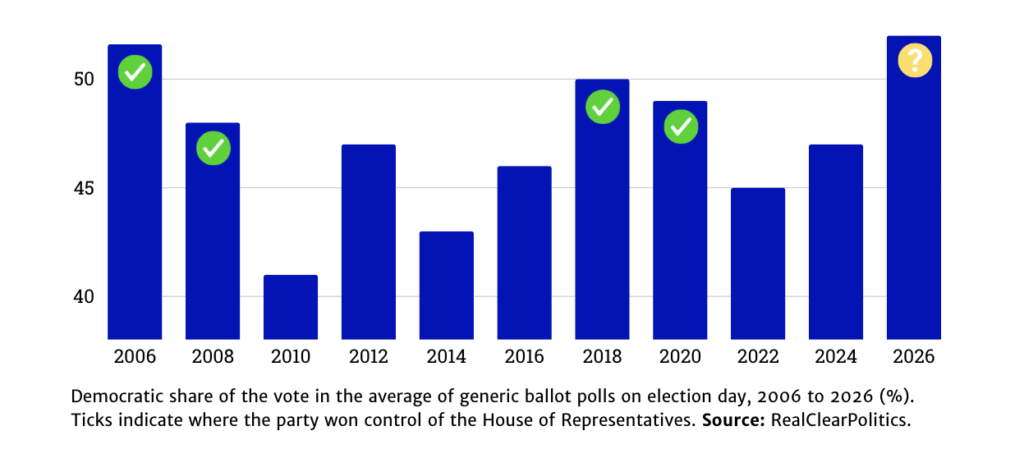
Democrats also lead the generic ballot, which asks voters which party they want in charge of Congress. The average stands at 52% to 43%, a nine-point lead. Individual polls vary widely, so the lead is best read as a direction of travel rather than a precise figure. Regardless, 52% is the highest share the Democrats have held in the average of polls on the day of the congressional election since… 2006.
The House: a clear lead for Democrats
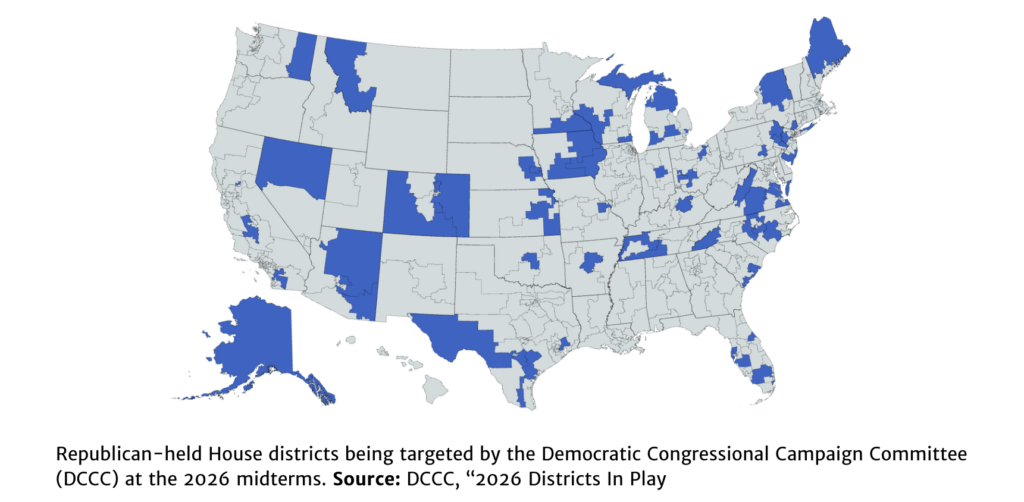
A nine-point lead would give the Democrats between 230 and 240 of the 435 seats, against 218 needed for a majority. They would gain seats across the swing states of Pennsylvania, Ohio, Michigan and Arizona, and in more Republican territory such as Montana’s 1st Congressional District (CD), North Carolina’s 11th, Kentucky’s 6th and Missouri’s 2nd. In South Carolina’s 1st CD, these numbers would leave the Democrats winning by a few hundred votes in a seat the Republicans took by 17 points two years ago. These are seats the Democratic Congressional Campaign Committee are targeting – an indicator of how they thing the night could go.
One might assume that mid-decade redistricting at the president’s urging would shore up some Republican seats. In the US, parties can redraw a seat’s boundaries to favour one side, a practice known as gerrymandering, and it is a highly politicised process. In some seats redrawn to favour Republicans, it appears to have backfired.
In Texas’s 15th CD, Republicans were confident the new boundaries would return the seat to their column once all votes had been counted. Democrats are now forecast to gain it. The same is true in Florida’s 22nd CD and Alabama’s 2nd CD.
Democrats have used the tactic too. The party redrew California’s map and sought to do the same in New York, Virginia and Maryland. The practice is unpopular with the American public. A recent YouGov survey found that 71% of voters say partisan gerrymandering should not be allowed, including 74% of Democrats and 69% of Republicans.
The Senate: Republicans defending seats almost everywhere
In the Senate, Democrats will be hoping to avoid what is often a disappointing result in hostile territory. Senate seats are contested statewide, so Democrats need to compete for rural and ex-urban votes as well as running up margins in the cities and suburbs.
The party currently has 47 seats, including two independents who caucus with them, against 53 for the Republicans. Winning 50 seats is not enough, because in a 50-50 Senate Vice President JD Vance can cast tie-breaking votes. The Democrats must therefore gain a minimum of four seats to win control of the chamber.
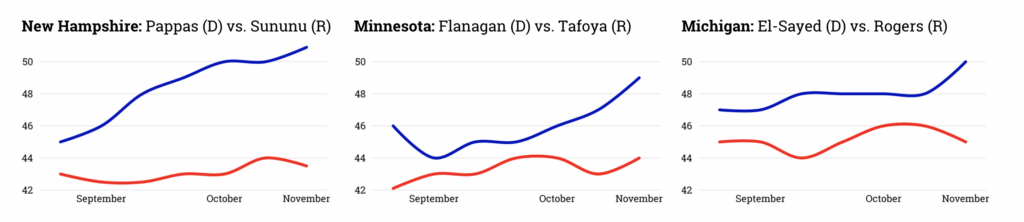
They first need to hold every seat they currently have. In Georgia, Jon Ossoff leads by more than 10 points. In New Hampshire and Minnesota, Democrats now lead by 7 points, after a summer in which Republicans felt more optimistic about both. In Michigan, a primary between the progressive Dr Abdul El-Sayed and the moderate Congresswoman Haley Stevens exposed divisions within the party. They continued long after the primary, and Stevens endorsed the Republican candidate three days before polling day.
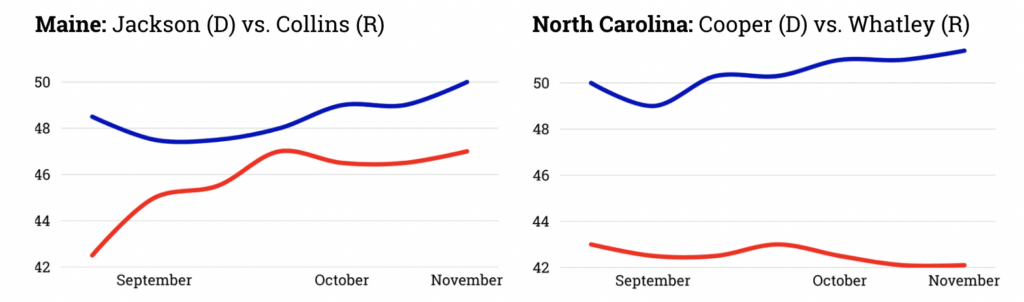
Beyond these, Maine looks like the easiest gain. Kamala Harris won the state by 7 points in 2024, and polls consistently put the Democratic candidate ahead of Senator Susan Collins, the long-time Republican incumbent. Collins is seen as a moderate in her party. She voted to convict Trump in 2021, supported Joe Biden’s nomination of Justice Ketanji Brown Jackson in 2022 and voted against the ‘One Big Beautiful Bill’ Act. She has highlighted her record of working across the aisle to get results for Maine. However, Gallup finds that 59% of American voters see the Republican Party as ‘too extreme’, and Democratic ads claim Collins votes with Republicans 96% of the time. That may prove hard for her to overcome.
North Carolina should be another early gain. Democrats have fielded Roy Cooper, the former two-term governor, who is a well-known figure in a state that last voted for a Democratic senator in 2008. He has maintained high approval ratings among independents and moderate Republicans, and has a large campaign fund. His opponent, Michael Whatley, is a political strategist and former chairman of the Republican Party, with lower name recognition and net-negative favourability ratings. Polling puts Cooper more than 10 points ahead. If the result matches the polling, he could achieve the largest margin for either party in the state since 1966. A win would also give Democrats a foothold in a state they last won at presidential level in 2008.
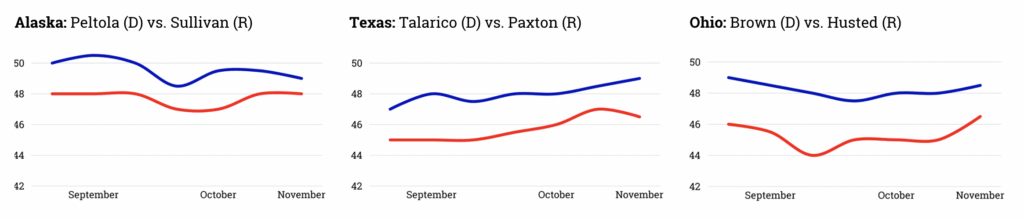
Three further gains could come from more Republican territory: Alaska, Ohio and Texas. Trump carried these states at presidential level by an average of 13 points. Democrats are competitive there largely because of their candidates, including in Texas, which has not elected a Democratic senator since 1988.
In Alaska, former Congresswoman Mary Peltola is challenging incumbent Senator Dan Sullivan. She is popular, has a record of outperforming the polls and can point to high fuel prices in the state. Another ‘Dan Sullivan’ has also entered the race. Polling at roughly 4%, he appears to be drawing votes from the incumbent, helping Peltola to sustain her lead on the slogan ‘Fish, Family, Freedom’. Peltola’s campaign has faced scrutiny over allegations that it sought to recruit the other Dan Sullivan, and Republicans have threatened not to seat her if she wins.
In Texas, Democratic nominee James Talarico, a state representative and seminarian, has made the race competitive by outperforming typical Democratic baselines with moderates, suburban voters and independents. The Republican nominee, Ken Paxton, is the state’s attorney general. He was impeached by the Republican-led Texas House in 2023 on allegations of corruption and bribery, and acquitted by the state Senate. He continues to face legal proceedings and ethics investigations, as well as divisions within his party. Paxton’s primary victory over long-time incumbent Senator John Cornyn has left some moderate conservatives in the fast-growing Dallas-Fort Worth and Austin suburbs unhappy. Some may stay at home or vote for Talarico, including the family of former president George W Bush. Paxton will rely heavily on very high rural turnout to hold the seat. Talarico’s broad coalition and growth in suburban support have prompted national Republicans and Elon Musk to commit late defensive funding to a state they long considered safe.
In Ohio, Sherrod Brown, the former Democratic senator who lost his seat in 2024, retains a slight edge over Republican incumbent Jon Husted. Husted was appointed to the seat after JD Vance became vice president, and so lacks the statewide voting base of a traditional incumbent. Brown has used his blue-collar populist brand to target what he sees as Husted’s main vulnerability: local backlash over the expansion of data centres. Residents across rural and suburban Ohio face rising utility bills and land disputes over tax-subsidised developments, and Brown has framed Husted as responsible for corporate giveaways to technology firms. With strong leads among independents, Brown’s economic message has brought back into play a state that had trended Republican since 2012.
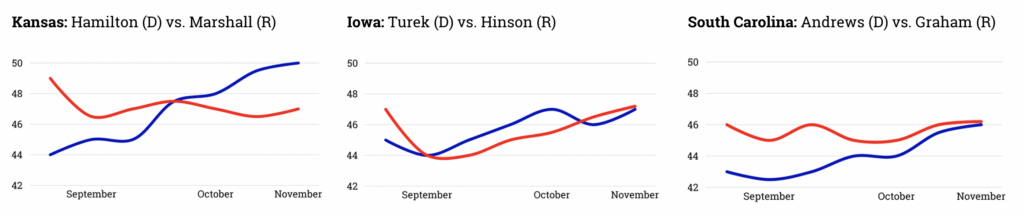
Democrats are also reaching into even more Republican territory. Polling suggests they could gain the Senate seat in Kansas, and in Iowa, a state that has moved away from them since they last won it at a presidential election in 2012. Mississippi and South Carolina could also be close, with polling suggesting Democrats could come within a couple of points. Across the Great Plains, independent candidates backed by Democrats are using their lack of party baggage to challenge Republicans in Montana, Idaho, Nebraska and South Dakota. In short, Republicans are defending seats in almost every state they hold.
Saying all of this, nothing is certain. Forecasters give Republicans between and 25% and 35% chance to win the Senate – which are actually decent odds. Given the small, yet steady margins amassed by Democrats, control of this chamber is just a regular-sized polling error away – and these have certainly characterised American politics in the last decade…
What to watch out for tonight
The polls point in one direction, but midterms turn on turnout and on a small number of close contests. Polling in individual Senate races has missed by several points in recent cycles, and an error of that size could change the outcome in the chamber.
The first polls close from around 11pm UK time. Results in Kentucky’s 6th and North Carolina’s 11th would show early whether the Democratic advantage is as large as the polls suggest. In the Senate, Ohio and North Carolina could be among the first key indicative calls. If both go to the Democrats, the route to four gains stays open and attention turns to Maine, Alaska and Texas. The first two can take days to count, so a clear Senate picture may not emerge by morning.
For those of us working with UK and international stakeholders, the result matters beyond Washington. Divided government would shift power towards congressional committees, whose chairs shape the debate on trade, defence spending and support for Ukraine. The most useful question tonight is how far the national mood carries down the ballot, and whether candidate strength in individual states can alter what the polls suggest.
While these elections may be over by tomorrow morning, Wednesday 4 November marks the first day of the 2028 presidential election campaign, and the start of another unpredictable cycle for the US and the world.